
Blog
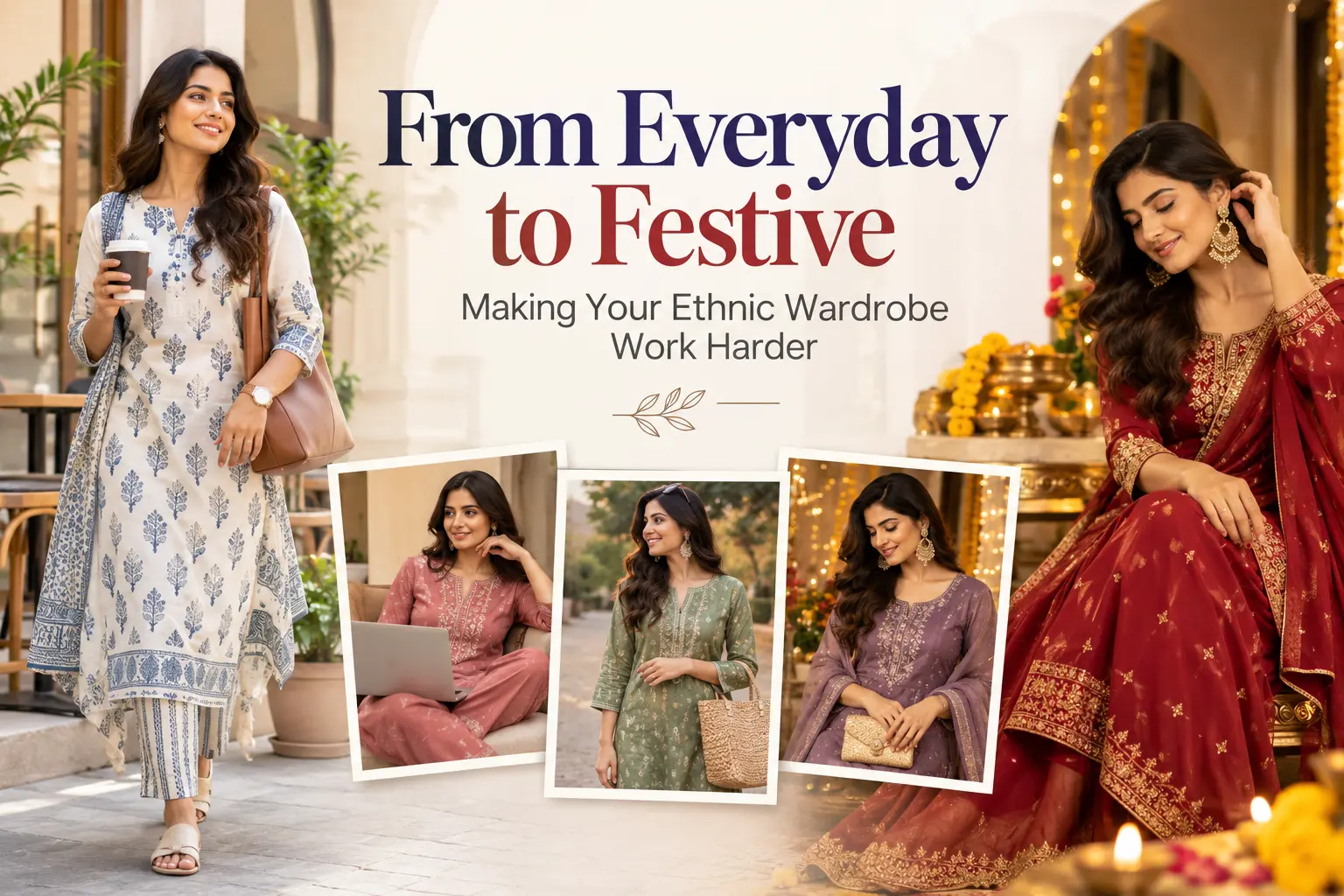
From Everyday to Festive | Making Your Ethnic Wardrobe Work Harder

A wardrobe does not become useful because it has a lot of clothes in it. It becomes useful when the clothes inside it can keep up with the life you actually live.
There are workdays, ordinary afternoons, unexpected plans, family lunches, small gatherings, festivals, weddings and evenings when you simply want to dress a little better than usual. Buying a different outfit for every one of these occasions is neither necessary nor realistic. What makes more sense is having a collection of ethnic wear that can move comfortably between everyday dressing and occasions that call for something special.
This is one of the reasons ethnic wear for women continues to have such a strong place in Indian wardrobes. A kurti can be an everyday favourite. A suit can be worn to work and styled differently for a family gathering. A co-ord set can be kept simple during the day and dressed up for dinner. A well-chosen festive suit may be reserved for celebrations, but it can still be worn more than once and styled each time differently.
The idea is not to own more.
It is to make better use of what you already choose to own.
The Everyday Wardrobe Should Have More Than One Purpose
Most women have a few outfits they reach for without thinking.
They are comfortable, familiar and easy to style. You already know which footwear works with them, which earrings look right and how the outfit feels after several hours of wearing it.
These are valuable pieces.
For everyday ethnic wear, comfort should be taken seriously. A beautiful outfit that feels uncomfortable after an hour is unlikely to become a wardrobe favourite. On the other hand, a simple kurti that fits well and feels good can end up being worn far more often than something bought purely because it looked impressive in a photograph.
Kurtis, lighter suit sets and comfortable co-ord sets can form the foundation of an everyday ethnic wardrobe. Depending on your routine, these can work for office wear, shopping, college, casual meetings, running errands, visiting family or simply spending a day outside.
Colour and print give you plenty of room to change things without changing the basic idea of what you wear.
A subtle print can be ideal for regular use. A brighter colour can make the same type of outfit feel more lively. A simple embroidered detail can add interest without making the piece too formal.
One Outfit Can Look Different on Another Day
There is a useful habit worth developing when buying clothes: stop thinking of an outfit as having only one possible look.
Take a straightforward kurta set.
With flats, small earrings and a simple handbag, it can remain an everyday outfit. Add a dupatta, slightly dressier jewellery and different footwear, and the same clothing can work for a family dinner or a small gathering.
The garment has not changed.
The way you have used it has.
This is particularly useful when building an ethnic wardrobe for women because ethnic clothing already gives you plenty of options for styling. Dupattas, jewellery, footwear, bags and layering can change the overall appearance without requiring a completely new outfit.
| A good wardrobe gives you options. A good outfit gives you more than one way to use those options.
Workwear Does Not Have to Be Boring
Office dressing often gets reduced to a small set of predictable choices.
There is no reason for that.
Ethnic workwear can be simple without looking dull. Straight kurtas, understated prints, coordinated sets and well-fitted suit combinations can look polished while remaining comfortable throughout the day.
The trick is not to make the outfit unnecessarily complicated.
If the kurta has a strong print, keep the rest of the styling quiet. If the outfit has interesting detailing, let that do most of the work. If you are wearing a simple solid-coloured piece, a good pair of earrings or a printed dupatta can add some personality.
Workwear is also where versatile clothing proves its value. A suit that looks appropriate for the office can sometimes be styled differently for an evening plan simply by changing the accessories.
That makes it a far better use of wardrobe space than buying something specifically for every individual situation.
When the Weekend Calls for Something Better
Weekends often sit in that comfortable space between everyday dressing and dressing up.
You may have lunch with friends, visit relatives, go shopping, attend a small get-together or simply spend the day outside. You want to look presentable, but you do not necessarily want to dress as though you are attending a wedding.
This is where co-ord sets and contemporary ethnic wear can be particularly useful.
A coordinated outfit already gives you a finished appearance, while still leaving room for personal styling. Add simple jewellery and comfortable footwear for the afternoon. Change to statement earrings and dressier sandals for the evening.
The same idea works with a printed suit or a well-cut kurta.
You do not need to make the outfit look elaborate. You simply need to understand what the occasion calls for.
Festive Clothing Deserves Its Own Place
Festivals bring a different mood to dressing.
Across India, celebrations give women many reasons to bring colour, traditional prints, embroidery, dupattas and more detailed outfits back into regular rotation. Whether it is Diwali, Eid, Raksha Bandhan, Karva Chauth or another cultural celebration, clothing becomes part of the occasion itself.
This is where your wardrobe can move from everyday ethnic wear into something more festive.
A Pakistani replica suit can make a strong choice when you want a more detailed look. An unstitched suit gives you the freedom to decide how you want the finished outfit to fit and look. A ready-made suit can be a convenient choice when you want the outfit sorted without spending time on tailoring.
The important thing is not to assume that festive means heavy.
A beautiful colour combination, thoughtful detailing or an attractive print can be enough to make an outfit feel suitable for a celebration.
There is no need to make every festive outfit heavily embroidered or uncomfortable.
The Difference Is Often in the Styling
Sometimes the clothes you already own are perfectly suitable for an occasion. They simply need to be styled differently.
Consider a simple kurti you normally wear with trousers and flats. Add a contrasting dupatta, earrings and a different pair of shoes, and the overall appearance changes considerably.
The same applies to a suit.
For a regular day, you might wear it with minimal jewellery. For a family function, you can bring out a more traditional pair of earrings and a matching dupatta. For an evening event, a different bag and footwear may be enough to give the outfit a more dressed-up appearance.
This is particularly useful for women who do not want to keep buying clothes for every celebration.
A wardrobe becomes much more manageable when you learn how to style what you already have.
Unstitched Suits Give You More Control
There is a particular advantage to owning an unstitched suit in a versatile wardrobe.
Instead of accepting a fixed silhouette, you have more control over the finished garment. The length, fit, sleeves and other details can be decided according to your own preference and measurements.
That can make an unstitched suit useful for occasions where you want something that feels more personal.
One fabric can also be interpreted differently depending on how it is stitched. A simpler cut may make it suitable for regular or semi-formal wear, while more detailed tailoring can make it appropriate for a festive occasion.
For women who already know what fits them well, this flexibility can be especially valuable.
Ready-Made Does Not Mean Less Personal
On the other side, ready-made suits offer something equally important: convenience.
Not everyone wants to spend time selecting a tailor, discussing measurements or waiting for an outfit to be stitched. Sometimes you simply want to find something you like, choose your size and wear it.
That is where ready-made ethnic wear fits naturally into a busy wardrobe.
A good ready-made suit can become an everyday favourite or an occasion outfit depending on its design. The convenience does not make it less personal. Your choice of colour, styling and accessories still makes the outfit yours.
Semi-Stitched Sits Somewhere in Between
For women who want some flexibility without starting completely from scratch, semi-stitched suits can be a useful middle ground.
They allow certain aspects of the final fit to be adjusted while keeping some of the work already done.
The right choice depends on how you prefer to shop.
Some women enjoy the freedom of an unstitched suit. Others value the convenience of ready-made clothing. Some prefer having a little control while avoiding the work involved in completely unstitched pieces.
There is no universal answer.
Your wardrobe should work according to your habits, not someone else’s.
Build Around the Clothes You Actually Wear
One of the easiest ways to make an ethnic wardrobe more useful is to pay attention to your own behaviour.
Which colours do you repeatedly pick?
Which outfits stay untouched?
Do you usually prefer kurtis or full suit sets?
Do you enjoy wearing dupattas?
Do you need more office-friendly clothing or more festive outfits?
Do you prefer ready-made clothing, or do you like getting suits stitched according to your measurements?
These questions may sound simple, but their answers can tell you far more about your wardrobe than a list of fashion trends.
If most of your week is spent at work, your wardrobe should reflect that. If you regularly attend family functions, you will need more occasion-friendly pieces. If you are someone who likes to dress traditionally even on ordinary days, then everyday ethnic wear should naturally occupy more space.
There is no reason for your wardrobe to look like someone else’s.
Do Not Save Everything for a Special Occasion
There is another habit many of us have inherited: keeping good clothes aside.
The beautiful suit is saved for the right function. The new kurta is kept untouched. The favourite outfit waits for an occasion that feels important enough.
Sometimes that occasion never comes.
Clothes are meant to be worn.
If you genuinely like an outfit, there is nothing wrong with wearing it to a family lunch, dinner or even an ordinary day when you feel like dressing up. Not every good outfit needs to wait for a wedding invitation.
In fact, some of the clothes we remember most fondly are the ones we wore repeatedly.
Buy With the Next Few Occasions in Mind
Before purchasing another outfit, it can help to think beyond the immediate reason for buying it.
Ask yourself where else you could wear it.
Could the kurti work for office and weekends?
Could the suit work for a family gathering as well as a festival?
Could the co-ord set be dressed up for dinner?
Could the colour work with jewellery and footwear you already own?
Could an unstitched suit be tailored in a way that gives you more than one styling possibility?
These questions turn shopping into something more considered.
You are not simply buying another garment. You are adding another useful piece to your wardrobe.
Choosing Ethnic Wear Online
Shopping for ethnic wear online also becomes easier when you know what you are looking for.
Product photographs are important, but they should not be the only thing you consider. Read the fabric information, check the measurements and understand exactly what comes with the outfit.
If it is a suit, check whether it is unstitched, semi-stitched or ready-made. If a dupatta or bottom is shown in the photograph, make sure it is included in the product details.
Look carefully at colours and detailing as well. Screens can sometimes show shades differently from how they appear in person, so detailed product information and clear photographs are particularly useful when shopping online.
The more information you have before ordering, the easier it becomes to choose something that genuinely belongs in your wardrobe.
What We Look for at Zunaira
At Zunaira, the idea of carefully chosen clothing is important to how the collection is put together. The brand focuses on women’s ethnic and traditional wear across unstitched suits, ready-made suits, semi-stitched suits, Pakistani replica suits, co-ord sets and kurtis.
These categories serve different parts of a woman’s wardrobe. Some pieces are better suited to everyday wear, while others naturally belong to festivals, celebrations, weddings and family gatherings. The brand’s existing customers have particularly chosen Pakistani replica suits, unstitched suits and ready-made suits for festive occasions and celebrations, while kurtis, co-ord sets and ready-made suits are also used for office wear, casual outings, daily wear and social gatherings.
That difference is worth recognising because there is no single definition of useful ethnic wear.
A wardrobe needs variety, but that does not mean endless variety. It means having the right mix of pieces for the way you live.
Zunaira’s own philosophy is centred on selecting designs that the family would confidently recommend to their own family and friends, rather than simply trying to sell clothing in bulk.
That way of looking at clothing makes sense when you think about a real wardrobe.
A woman should be able to open her cupboard and find something for Monday morning, something for Sunday lunch, something for a family gathering and something for the next festival.
She should not have to start from zero every time there is somewhere to go.
Make Your Wardrobe Work for Your Life
The most useful ethnic wardrobe is not necessarily the biggest one.
It is the one where everyday kurtis sit comfortably beside festive suits. Where a co-ord set can be dressed up when needed. Where an unstitched suit gives you room to create the fit you prefer. Where a ready-made suit saves you time on a busy week. Where the clothes you bought for one celebration can still find their way into another occasion months later.
That is what makes a wardrobe work harder.
Buy thoughtfully. Wear often. Style differently. Keep the clothes that earn their place.
Ethnic clothing has always had enough variety to do all of this. It can be simple on Monday, polished on Wednesday, festive on Friday and traditional again when the next family celebration arrives.
The occasion may change.
Your wardrobe does not have to start over each time.