Blog
Why Ethnic Wear Still Belongs in Every Woman’s Wardrobe

There are some clothes that come and go with fashion. They are popular for a season, photographed everywhere, and then slowly find their way to the back of the wardrobe. Ethnic wear has never quite followed that pattern.
A well-loved kurta, a good suit, a favourite dupatta or a beautifully chosen co-ord set often stays with us for years. Sometimes it is worn to a family gathering. Sometimes to work. Sometimes for a festival or a wedding. And sometimes simply because it is Tuesday and you feel like wearing something that makes you feel like yourself.
That is perhaps the simplest reason ethnic wear for women continues to have such an important place in Indian wardrobes. It is not limited to one occasion, one age group or one particular style of dressing. It has managed to remain connected to tradition while becoming part of everyday life.
| Good clothing does not have to choose between tradition and modern life. It can belong to both.
Ethnic Wear Is More Than Occasion Wear
For a long time, ethnic clothing was often associated with festivals, weddings and family functions. You would bring out the heavier suits, sarees or embroidered outfits when there was somewhere special to go.
That is still a part of it, and perhaps always will be. There is something special about dressing traditionally for a celebration.
But the Indian wardrobe has changed.
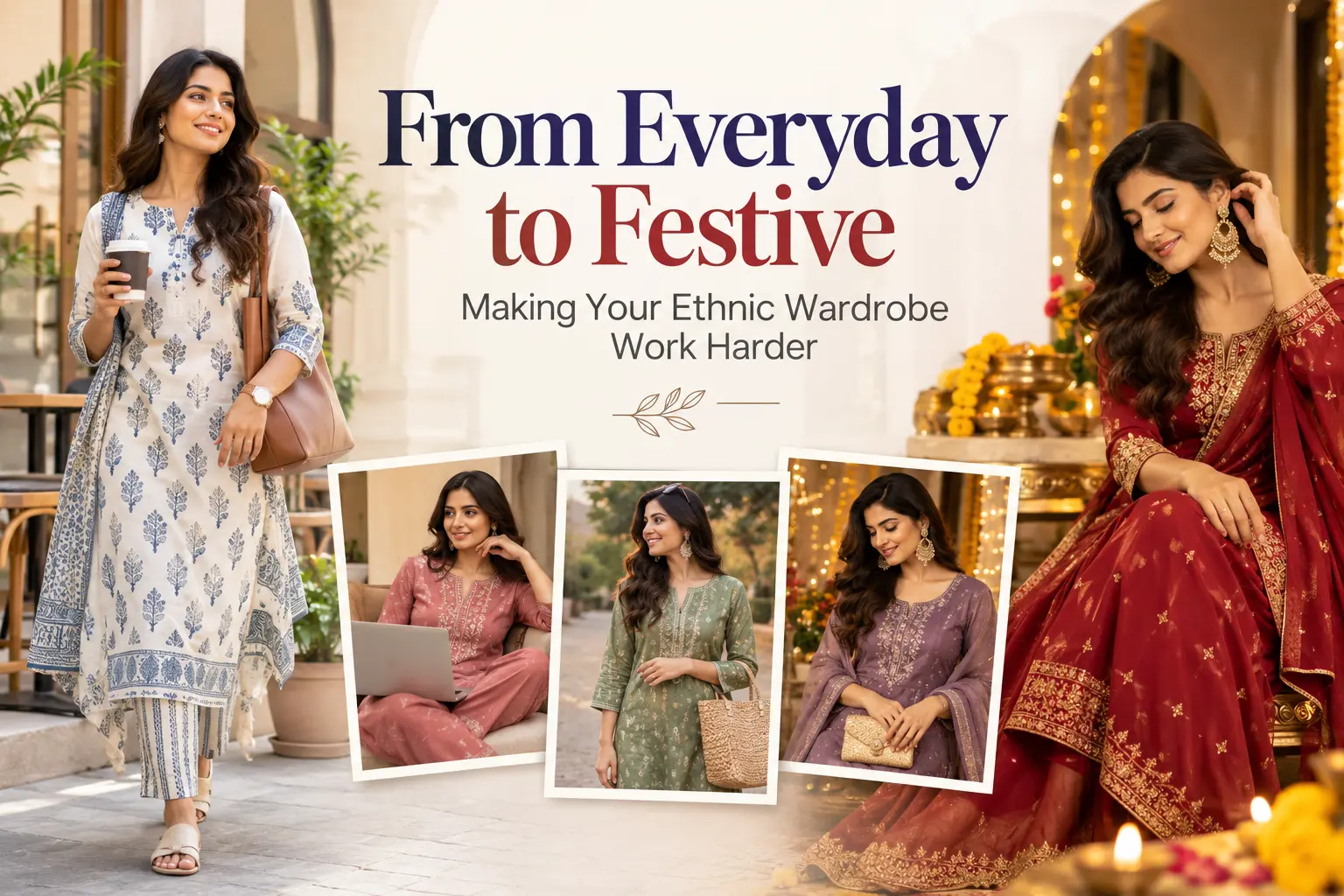
Today, women wear kurtas to work, co-ord sets for lunches, kurtis for everyday outings and comfortable suit sets for family visits. A traditional silhouette can be paired with contemporary styling, while a simple outfit can be dressed up with jewellery, footwear or a dupatta when the occasion calls for it.
Recent industry research also reflects this wider role. Women’s ethnic wear in India is no longer being treated only as an occasion-led category; market research describes it as a mainstream clothing choice with demand across both daily and festive wear.
That change matters because it tells us something quite ordinary and quite important: women are not wearing ethnic clothes only because they have to dress traditionally. They are wearing them because they like them.
There Is Something Familiar About Ethnic Clothing
Fashion changes quickly. Colours change. Cuts change. Fabrics come and go. New styles appear every season.
Yet ethnic clothing has a familiarity that is difficult to replace.
A kurta can remind you of something your mother wore. A particular print can take you back to a festival. A dupatta may remind you of a wedding in the family. Even a simple suit can become associated with a particular period of your life.
This connection is one of the reasons traditional clothing continues to hold its place.
Indian clothing has always carried regional influences, different fabrics, embroidery styles, prints, silhouettes and ways of wearing the same garment. A cotton kurta from one part of the country can look completely different from a festive suit inspired by another. That variety gives women plenty of room to find something that feels personal.
And perhaps that is what makes Indian ethnic wear so interesting. It does not have one fixed appearance.
Ethnic Wear Can Work for Everyday Life
One of the biggest strengths of ethnic clothing is its versatility.
A simple kurti can work for a regular day. A comfortable printed suit can be worn for a family lunch. A well-fitted ready-made suit can take you from a casual meeting to an evening gathering with only a few changes in accessories.
Then there are co-ord sets, which have become an increasingly visible part of contemporary ethnic dressing. They bring the ease of coordinated dressing without taking away the familiar character of Indian clothing. Current fashion content from established ethnic-wear brands also reflects this movement towards clothing that can work across different occasions rather than being kept only for festivals.
This is where ethnic clothing becomes particularly useful in a real wardrobe.
You do not need an outfit for every possible situation. You need clothes that can work with your actual life.
| The best wardrobe is not the one filled with clothes. It is the one filled with clothes you actually wear.
A Good Ethnic Wardrobe Does Not Need to Be Huge
It is easy to think that having a beautiful wardrobe means constantly buying something new.
It does not.
A thoughtful ethnic wardrobe can begin with a few dependable pieces. A couple of comfortable kurtis. A good everyday suit. Something slightly more detailed for family occasions. A versatile co-ord set. A festive outfit that you genuinely look forward to wearing.
From there, you can build according to your own lifestyle.
Someone who works in an office may want more straight kurtas and subtle prints. A college student may prefer relaxed kurtis and co-ord sets. Someone who attends many family gatherings may want more suit sets and occasion-ready pieces. Another woman may simply love traditional clothing and want a wardrobe full of colour, prints and beautiful dupattas.
There is no single formula.
The point is to choose clothes that make sense for your life.
Traditional Does Not Mean Old-Fashioned
This is another reason ethnic wear continues to remain relevant.
Traditional clothing has changed with the women who wear it.
Necklines have changed. Sleeves have changed. Fits have become more relaxed. Prints have become more varied. Colours have moved beyond the familiar combinations. Co-ord sets and contemporary cuts have found their place alongside classic suits and kurtis.
Even the way women style ethnic clothing has changed.
A kurta can be worn with simple jewellery and flats for the day, then styled differently with statement earrings and dressier footwear for an evening occasion. A traditional outfit does not necessarily need traditional styling from head to toe.
That balance between the familiar and the new is what keeps the category relevant.
BIBA and Libas, for example, continue to publish styling content around kurtas, kurta sets, Anarkalis, everyday ethnic clothing and fusion dressing, reflecting how traditional silhouettes are being worn in contemporary settings.
Fabric Matters More Than We Sometimes Realise
A beautiful design is only part of the experience.
The fabric can decide whether you reach for an outfit again or leave it hanging in the wardrobe.
For everyday wear, many women look for fabrics that feel comfortable through long hours. For festive occasions, richer textures, detailing and more elaborate finishes may make sense. The right fabric also depends on the season, occasion and personal preference.
This is why buying women’s ethnic wear online requires a little more attention than simply looking at a photograph.
Look at the fabric details. Check the measurements. Understand whether the outfit is ready-made, semi-stitched or unstitched. Read the product description carefully. Look at the colours from different images where available.
A good purchase is not only about how the outfit looks on a screen. It is about whether the piece makes sense once it becomes part of your wardrobe.
Ethnic Wear Belongs to Every Generation
Another reason ethnic clothing has remained so strong is that it does not belong to one particular age.
A young woman may choose a printed kurti with contemporary footwear. Another may prefer a classic suit with a dupatta. Someone older may have her own favourite silhouettes, colours and fabrics that she has trusted for years.
The same basic idea can look completely different on different women.
That is a strength, not a limitation.
Ethnic clothing gives women room to dress according to their personality rather than asking everyone to look the same. It can be colourful or understated, traditional or contemporary, simple or detailed.
And there is no age at which a woman has to stop wearing it.
The Occasion Does Not Always Have to Be Special
Perhaps this is the biggest change in the way we look at ethnic wear today.
We no longer need to wait for a wedding, festival or family function to wear something traditional.
Sometimes you wear your favourite kurta because you have a busy day ahead and want to be comfortable. Sometimes you choose a beautiful suit for a family lunch. Sometimes you wear a co-ord set because you like how it looks.
Not every outfit needs a grand occasion behind it.
Some clothes become favourites simply because they fit into ordinary life.
That is where ethnic fashion for women has found its real strength. It can be part of celebrations, but it can also be part of Mondays, workdays, shopping trips, family dinners and quiet weekends.
Building a Wardrobe That Feels Like You
There is no perfect ethnic wardrobe.
There is only the wardrobe that works for you.
Choose pieces you can see yourself wearing. Look beyond what is trending for a few weeks and think about what you genuinely like. Pay attention to fabric, fit, colour and comfort. Keep a mix of everyday pieces and outfits for occasions. And do not be afraid to repeat something you love.
Clothing is meant to be worn.
At Zunaira, this is the thought behind the collections we choose. From unstitched and ready-made suits to semi-stitched suits, Pakistani replica suits, co-ord sets and kurtis, the focus is on bringing together ethnic and traditional wear that women can actually see themselves wearing. The brand was started by a family in January 2025 with a simple belief in carefully chosen clothing, quality, trust and a shopping experience that feels personal.
We do not believe ethnic wear needs to be complicated to be beautiful.
Sometimes the right colour is enough. Sometimes it is the fabric. Sometimes it is a print you cannot stop thinking about. And sometimes it is simply that feeling of putting something on and knowing, without much thought, that this is exactly what you wanted.
| Tradition stays relevant when it continues to have a place in real life.
And that is why ethnic wear still belongs in every woman’s wardrobe.
Not because every woman has to dress traditionally.
Not because fashion says she should.
Simply because after all these years, ethnic clothing still gives women something very few categories of clothing can offer: the freedom to carry something familiar into the life they live today.